
Spanish for kids: learn through real native speakers
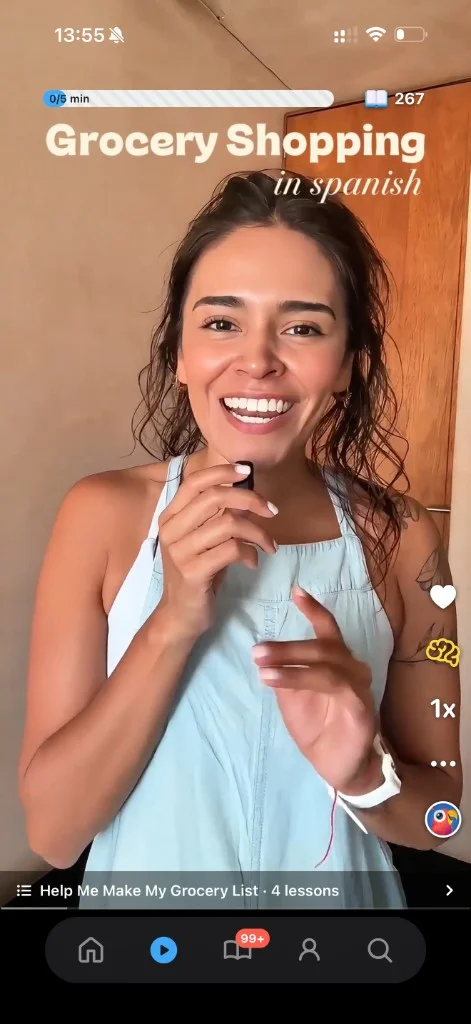
Your child learns Spanish the way they learned their first language: through real native speakers in short videos. No grammar drills, no cartoon voices, no vocabulary ceiling.

4.7 on the App Store810,959 learners
Quick answer
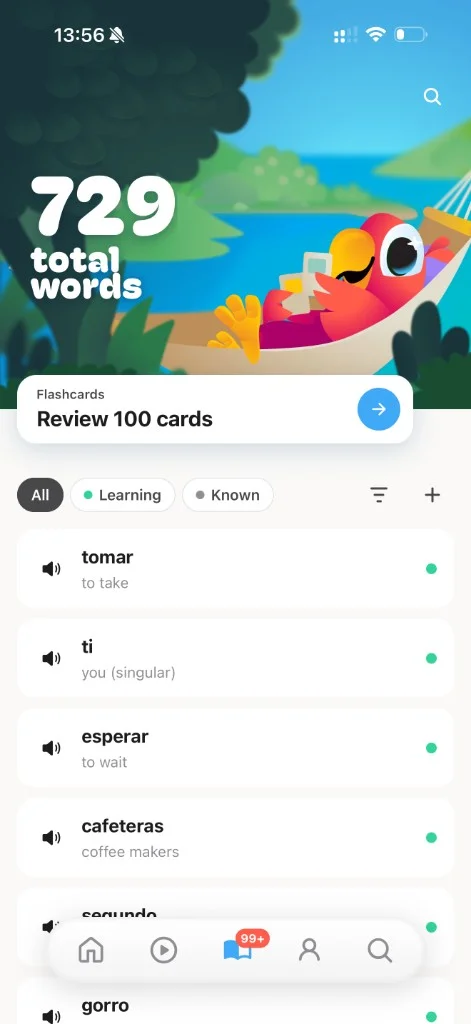
Spanish for kids that isn't just a game: Parrot is a short-form video app for learning Spanish, built on Dr. Stephen Krashen's comprehensible input research, with videos from native speakers around the world, including Mexico, Colombia, Argentina and Spain. It is rated 13+ on the App Store, so it suits teens and parents learning alongside younger kids. Tap any word to translate it and save it to a personal dictionary reviewed with spaced repetition.
Available on iOS, Android, and web. Over 810,959 learners have used Parrot.
Key takeaways
- 01
Parrot uses real native-speaker videos, not cartoon voices or games
Every video stars native speakers from around the world, delivering authentic pronunciation and natural speech patterns from day one. Kids hear real Spanish the way it's actually spoken, not simplified cartoon dialogue.
- 02
Built on comprehensible input and Dr. Stephen Krashen's research
Parrot is built on Dr. Stephen Krashen's comprehensible input research: we acquire language by understanding messages in context, not through grammar drills.
- 03
Personalized sequencing adapts to each learner's pace
Everyone learns at a different pace and Parrot adapts to each learner. Videos are sequenced so learners understand about 80% and stretch for the rest.
- 04
Every video is screened by a person for safety and quality
Every piece of content is screened by a person, and Parrot is rated 13+ on the App Store, so it suits teens and parents learning alongside younger kids. None of Parrot's audio or video is AI-generated.
- 05
Flight School guides day-one beginners through foundational Spanish
Complete beginners can start with Flight School, a beginner course built for day one. Level is set from the learner's onboarding answers plus a short placement test.
How kids can learn Spanish from real video.
Real video gives Spanish in context
- Kids don't learn first language through games
- Memorization doesn't build comprehension
- Kids complete levels but retain nothing
Cartoon voices don't prepare kids for real Spanish
- Slowed-down audio sounds nothing like natives
- Authentic rhythm is missing
- Kids struggle with real speakers later
Most apps cap at preschool vocabulary
- Colors, animals, then nothing
- No path beyond age 6 content
- You're switching apps every year
Your child needs a method, not just entertainment
- Fun animations don't equal acquisition
- Without methodology, screen time is wasted
- Parents need real measurable results

“I have been using this app for a while now and FINALLY I can express myself to my Mexican MEJOR AMIGA and I can communicate easier with her family too! YOU GUYS made my language learning journey so much easier!”
thatcutegirlyoumetonce 🇺🇸
 The Parrot Method for kids
How children learn Spanish naturally with Parrot.
The same four-step cycle that works for adults, calibrated for young learners, built on decades of research from Dr. Stephen Krashen at USC.
Listen and absorb through native-speaker video
Short videos with real native speakers on everyday topics. Just above your child's current level so they understand most of what they hear.
Repeat and build speaking confidence
Kids parrot back what they hear, same way toddlers learn to speak. Mimicking builds confidence without pressure.
Save words and review with spaced repetition
Tap to save. Review at scientifically optimal intervals so vocabulary moves into long-term memory.
Stay consistent with 15 minutes a day
Fluency comes from daily exposure, not marathon sessions. Short focused practice fits family schedules.
How learners use the feed
Scroll through short videos featuring real native speakers
The feed feels like TikTok, but every scroll teaches Spanish. Videos are about everyday life.
Tap any word to see its translation and save it
Learners tap unfamiliar words directly in the video to see translations. One tap saves the word to their personal dictionary for later review.
Learners have tapped over 20 million words in Parrot, building vocabulary naturally as they watch.
Parrot back what they hear to build speaking confidence
Speaking activities with pronunciation scoring are built into the listening experience. Parrot scores pronunciation with proprietary models it built and trained. Listening comes first; speaking is about 20% of the experience.
Read video transcripts with inline translation
Reading practice happens through video transcripts with inline translation. Kids can read along as they watch, connecting written Spanish to spoken words.
This builds reading comprehension alongside listening skills, reinforcing vocabulary in multiple contexts.
Outcomes for kids who use Parrot daily.
Fluency that grows over time
- Starts with simple phrases
- Progresses to real conversation
- Adaptive content avoids baby ceiling
Authentic pronunciation from day one
- Native speakers, not synthetic voices
- Natural rhythm and accent
- Lasting head start versus anglicized accents
Cognitive benefits beyond language
- Stronger problem-solving and memory
- Better focus and cognitive flexibility
- Compounds across school subjects
Cultural connection and confidence
- Connect with Spanish-speaking family
- Empathy through perspective
- Global awareness for a multilingual world
Screen time that builds skills
- Productive, not passive scrolling
- Measurable progress in 15 minutes
- Parents feel good about the time spent
Safe, focused, no distractions
- No ads, no accidental purchases
- No inappropriate material
- Time-bounded sessions by design
Content screened by a person, rated 13+
Every video is screened by a person before it goes live
Every piece of content is screened by a person. None of Parrot's audio or video is AI-generated.
Every video teaches real Spanish from native speakers.
Rated 13+ on the App Store for teens and parents learning together
Parrot is designed for teens and parents who want to learn Spanish alongside younger family members.
Parents learning with their children create shared milestones and practice opportunities at home, making the learning experience a family activity.
Streaks that build the habit, without the guilt-tripping
Parrot uses streaks because building a daily habit is a big part of learning a language, but never guilt-trips learners.
Content covers everyday life:work, health, travel, and culture
Videos star native speakers discussing everyday topics such as customer service and health situations. This prepares learners for actual conversations, not just classroom Spanish.
The library includes tens of thousands of videos, so learners encounter diverse accents, vocabulary, and contexts as they progress.
Who Parrot works for.
Parents who don't speak Spanish
- No Spanish skills required from you
- App delivers expert instruction
- You support, video teaches
Heritage families passing on the language
- Daily native exposure reinforces home
- Builds vocabulary beyond household speech
- Reading, writing, formal language too
Older kids who've outgrown cartoon apps
- Real-world content, not babyish
- Rated 13+ on the App Store
- Adapts as maturity grows
Busy families with limited time
- 15 minutes during breakfast or bedtime
- No commute, no tutor scheduling
- Fits packed family life
Why parents choose Parrot over Duolingo Kids and Studycat.
What families are saying about Parrot.
Backed by Y Combinator. Trusted by 810,959+ learners.
“I have been using this app for a while now and FINALLY I can express myself to my Mexican MEJOR AMIGA and I can communicate easier with her family too! YOU GUYS made my language learning journey so much easier!”
thatcutegirlyoumetonce 🇺🇸“My Colombian native boyfriend has told me how shocked he is at how well my Spanish is. I used Duolingo on and off for a few years and couldn't tell you a single thing I remember. In these past few days I've improved so much.”
 Aloïs Hasselwander 🇩🇪
“As someone who has always been interested in learning different languages I've struggled to stay consistent with apps like Duolingo. Parrot keeps me coming back every single day.”
 Amir 🇺🇸
“Parrot gets it. No boring grammar drills, no guilt-tripping streaks. Just real Spanish content that sticks in your brain. I've learned more in 3 weeks than a full semester of college Spanish.”
 worldtraveler99 🇺🇸
“I never thought scrolling could teach me a language. Parrot feels like TikTok but I'm actually learning. My friends are amazed I can hold a conversation in Spanish after just 2 months.”
 spanishlearner_22 🇬🇧
“The short video format is genius. I learn during my commute, during lunch breaks, before bed. It never feels like studying. I'm addicted in the best way possible.”
 linguafranca 🇺🇸
What daily practice looks like
Two months:holding basic conversations with native speakers
Learners who take it seriously can have a basic conversation in under two months.
One learner wrote: “My friends are amazed I can hold a conversation in Spanish after just two months.”
How Parrot adapts to each child's learning pace
Videos are sequenced so learners understand about 80% and stretch for the rest, and difficulty adapts as comprehension grows.
Progress shows inside the app: vocabulary progress, learning-path completion milestones, and streaks, so learners can see growth over time.
Practical tips for building a Spanish habit at home
Start with 15 minutes a day, not marathon sessions
Learners spend about 15 minutes a day on Parrot. Fifteen minutes fits breakfast, after school, or bedtime routines without overwhelming busy families.
Power users go well past an hour, but consistency matters more than duration. Short, focused practice compounds into real progress.
Keep learning relevant to everyday life
Videos are about everyday life, so there is plenty that keeps learners interested.
Use streaks to build the habit without guilt or pressure
Streaks track consistency without the pressure.
Encourage kids to parrot back what they hear out loud
Mimicking builds speaking confidence without the pressure of formal drills. Kids repeat phrases they hear in videos, practicing pronunciation in a low-pressure environment.
Review saved words together to reinforce vocabulary
Spaced repetition schedules reviews at optimal intervals, so vocabulary sticks long-term. Parents can review saved words with their children to reinforce learning.
How to start your child's Spanish journey today.
Most learners notice comprehension improvements within the first week.
Start your 7-day free trial
iOS, Android, and web. Your teen can begin watching immediately.
Match content to your child's level
Adaptive onboarding starts beginners with easy comprehensible video, jumps ahead for advanced learners.
Build a 15-minute daily habit
Breakfast, after school, or before bed. Short focused sessions compound into fluency.
Watch progress unfold week by week
Most parents notice their child using Spanish phrases naturally within the first month.
Essential beginner Spanish: words and phrases to start with
Greetings and polite words kids use every day
Hola (hello), buenos días (good morning), gracias (thank you), and por favor (please) are good first phrases to learn. They appear in real conversations, not isolated drills.
Flight School is Parrot's beginner course, built for day one.
Simple questions and answers for basic conversations
¿Cómo estás? (How are you?), estoy bien (I'm good), ¿qué es esto? (What is this?) and me gusta (I like it) are simple first questions and answers.
Hearing these phrases in native-speaker videos shows when and how to use them.
Family, food, and feelings:high-frequency words kids actually use
Mamá (mom), papá (dad), hermano (brother), agua (water), pan (bread), feliz (happy), and triste (sad) are high-frequency words in daily life. Hearing words in context from native speakers helps you connect them to real meaning.
As learners progress, difficulty adapts as comprehension grows.
Colors, numbers, and household items
Rojo (red), azul (blue), uno (one), diez (ten), mesa (table), and silla (chair) are easy first words.
Related pages
Your questions about Spanish learning for kids, answered.
What age is best to start learning Spanish?
Children can start as early as age 3 or 4, during the critical language acquisition window. Research shows kids who start before age 12 develop near-native pronunciation and fluency more easily. Parrot is rated 13+ on the App Store, so it suits teens and parents learning alongside younger kids.
How is Parrot different from Duolingo or other kids' apps?
Most kids' apps rely on gamification, cartoon characters, and simplified audio. Parrot uses real native speakers in short-form video so children hear authentic pronunciation from day one. Built on comprehensible input, the most researched method for natural acquisition.
Do I need to speak Spanish to help my child learn?
No Spanish skills required. Parrot delivers the native-speaker immersion your child needs through video, so you don't have to be fluent to support their learning.
Is Parrot safe for kids?
Parrot is rated 13+ on the App Store, so it suits teens and parents learning alongside younger kids. Every piece of content is screened by a person, and none of Parrot's audio or video is AI-generated.
How much time should my child spend each day?
15 minutes a day is enough to see consistent progress. Parrot is designed for short, focused sessions that fit into busy family schedules without overwhelming your child.
Will my child actually retain what they learn?
Yes. Parrot uses spaced repetition for long-term memory plus comprehensible input for context-based learning. Words are tied to real conversations, so understanding goes deeper than rote memorization.
Can Parrot help kids prepare for Spanish class at school?
Yes. Parrot builds listening comprehension and speaking confidence that can complement formal Spanish classes.
Videos are sequenced so learners understand about 80% and stretch for the rest, which keeps practice in the learning zone.
What if my child is already taking Spanish classes?
Parrot complements classroom learning by providing daily exposure to native speakers outside of school. Kids hear real Spanish at natural speed, reinforcing what they learn in class and filling gaps in pronunciation and listening comprehension.
Parrot can work as a supplement to school Spanish, with about 15 minutes a day of immersive practice.
What are the best free resources for teaching Spanish to kids?
Free resources like YouTube channels, printable worksheets, and interactive websites can introduce basic vocabulary. Parrot combines the engaging format of short-form video with a method built on Dr. Stephen Krashen's comprehensible input research, adaptive sequencing, and spaced repetition review.
Parrot is free to download with a 7-day free trial on the annual plan, with full Premium access.
How does Parrot's placement test work?
The placement test evaluates your child's current Spanish level and starts them at the right point in the learning path. This ensures they're neither bored with material that's too easy nor frustrated by content that's too advanced.
After the test, Parrot's personalized sequencing adapts to their progress, serving videos and exercises that match their growing comprehension.
Does Parrot teach Latin American Spanish or Spain Spanish?
Parrot's videos star native speakers from around the world, including Mexico, Colombia, Argentina, and Spain, so learners hear a range of accents and vocabulary.
Videos mix Latin American and Spain Spanish today. More granular accent options are coming soon.
Give your child a head start with real Spanish.
Join 810,959+ learners using comprehensible input: the science-backed way kids actually acquire language. Start your 7-day free trial.