
Spanish for beginners: start with Flight School
Flight School takes you from zero Spanish to confident conversations in just 15 minutes a day. No grammar drills, no verb tables, just real Spanish from native speakers that sticks.

4.7 on the App Store810,959 learners
What you need to start speaking Spanish for beginners
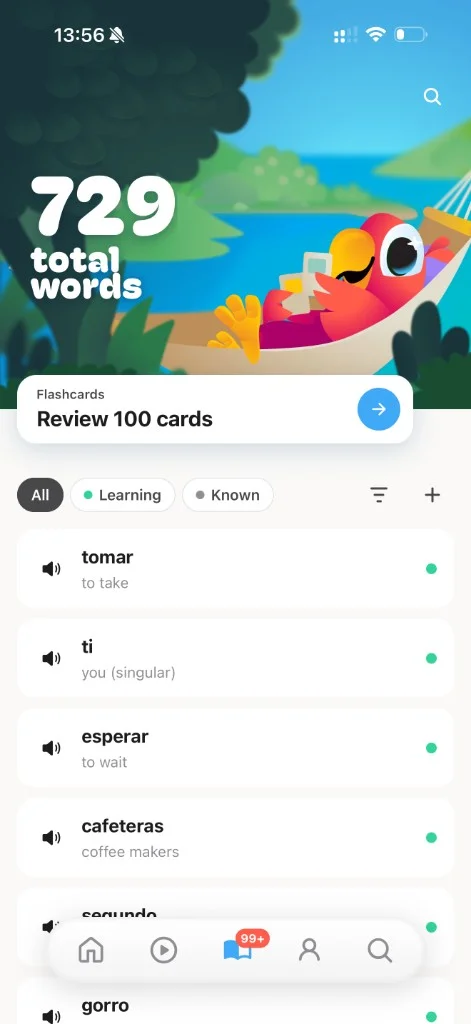
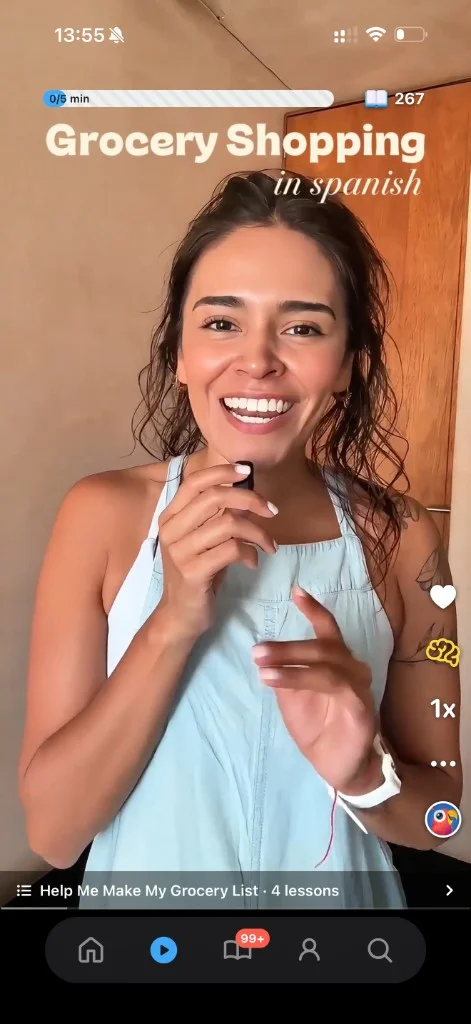
Parrot teaches Spanish for beginners through Flight School, a beginner course built on comprehensible input. You watch short videos from native speakers around the world, including Mexico, Colombia, Argentina and Spain, sequenced so you understand about 80% and stretch for the rest. Tap any word to save it, and spaced repetition brings it back at the right moment.
The method is 80% listening and reading, 20% speaking practice, designed to mirror how your brain naturally acquires language. Flight School is built for absolute beginners starting from zero, with a short placement test (5 minutes or less) that helps set your level from day one.
Key takeaways: how Flight School teaches Spanish for beginners
Five facts about learning Spanish with Flight School.
Flight School is a beginner course that uses comprehensible input, the method built on Dr. Stephen Krashen's research.
Flight School videos feature native speakers from Mexico, Colombia, Argentina, and Spain, sequenced so beginners understand about 80% of the content and stretch naturally for the rest.
In Parrot, a short placement test (5 minutes or less) plus your onboarding answers set your level from day one, keeping you in the learning zone.
In Parrot, you tap any word in the video transcript to save it to your personal dictionary, and spaced repetition brings saved words back at the right moment for long-term retention.
Learners who take it seriously can have a basic conversation in under 2 months, with everyone learning at a different pace as Parrot adapts to each learner.
Built for absolute beginners, so you can start speaking Spanish from scratch as an adult.
Grammar drills before you can say anything useful in Spanish
- Verb conjugation tables won't get you talking
- Translation drills teach you to think in English first
- By week 3 you've memorized rules but said nothing
Streak guilt instead of real progress
- Cartoon mascots punish you for missing a day
- Streaks measure showing up, not learning
- Burnout comes long before fluency does
Beginner content gets patronizing fast
- Apps repeat the same 100 phrases forever
- Nothing prepares you for real conversation
- The leap to native content feels impossible
Decision fatigue kills your habit
- Where do I even start? What's next?
- Browsing the library eats your 15-minute window
- Most beginners quit in the first 30 days

“My Colombian native boyfriend has told me how shocked he is at how well my Spanish is. I used Duolingo on and off for a few years and couldn't tell you a single thing I remember. In these past few days I've improved so much.”
Aloïs Hasselwander 🇩🇪
A guided 30-day path designed for true beginners.
Six features that hold your hand through week one and build the habit that takes you to fluency.
Flight School onboarding
- Structured for day-one learners
- Tells you exactly what to do next
- No guessing where to start
Short-form native-speaker video
- Real Spanish from real people
- 30 to 90 second clips
- Fits any schedule
n+1 difficulty for beginners
- Always slightly above your level
- Challenging but never overwhelming
- Comprehension grows naturally
Tap-to-translate transcripts
- Read along while you watch
- Tap any word for translation
- Save to your personal dictionary
Spaced repetition that sticks
- Saved words come back at the right moment
- Long-term memory, not cramming
- You stop forgetting what you learned
Streaks without the guilt
- Miss a day without losing progress
- Open the app when life allows
- Consistency, not perfection
What day one looks like: your first session with Flight School
Five minutes to personalize your feed
When you open Parrot for the first time, your level is set from your onboarding answers plus a short placement test that takes 5 minutes or less. Your first videos are matched to you from the start.
Why comprehensible input works from day one
Your first video is from a native speaker, matched so you understand most of it. Videos include transcripts with inline translation so you can read along.
The Parrot Method is built on comprehensible input theory. We acquire language when we understand messages, not when we memorize rules. You are listening, reading along, and letting your brain absorb the pattern.
Save your first words in seconds
As you watch, tap any word in the transcript that feels useful or unfamiliar. It saves to your personal dictionary automatically. No flashcard setup required.
Spaced repetition brings them back, right when your brain is ready to lock them in.
Fifteen minutes, no pressure to continue
Parrot is built around about 15 minutes a day, and you can stop anytime.
The goal is simple: watch a few videos, tap a few words, and let comprehensible input do the work.
 Your first 30 days
Listen, repeat, save, stay consistent.
A simple four-step cycle that turns daily comprehension into real conversation by day 30.
Week 1: Listen and absorb
Short videos build your ear for real Spanish. Tap any word to save it: don't try to memorize.
Week 2: Parrot back what you hear
Start repeating phrases out loud. Speaking confidence grows the moment you stop being afraid to fumble.
Week 3: Review with spaced repetition
Saved words return at the perfect moment. Week-one vocabulary now feels automatic.
Week 4: Real conversations click
By day 30, you understand full sentences without translating in your head. The habit is built.
What you'll learn first.
Everyday conversations, not textbook phrases
- Greetings, intros, asking and answering questions
- Talk about your day, plans, interests
- Skip phrases you'll never use in real life
High-frequency words first
- The first 1,000 words cover 80% of conversations
- Personal dictionary tracks what you save
- Spaced repetition locks them in long-term memory
Context over conjugation
- Verbs taught the way kids learn them
- Patterns absorbed naturally, not memorized
- Grammar makes sense once you've heard it used
Cultural nuance and slang
- Regional expressions textbooks skip
- Sound natural, not robotic
- Real fluency includes cultural fluency
Essential Spanish phrases and vocabulary for beginners
Greetings and everyday conversation starters
Common beginner greetings include 'Hola' (OH-lah, hello), '¿Cómo estás?' (KOH-moh ehs-TAHS, how are you?), and 'Buenos días' (BWEH-nohs DEE-ahs, good morning).
In Parrot you hear phrases like these in native-speaker videos with tap-to-translate transcripts, so you hear the pronunciation and see the context at the same time.
You can repeat phrases like '¿Qué tal?' (keh TAHL, what's up?) and 'Mucho gusto' (MOO-choh GOOS-toh, nice to meet you). The videos show real conversations, not textbook dialogues, so you learn how native speakers actually greet each other.
High-frequency words you will use every day
Words like 'gracias' (GRAH-see-ahs, thank you), 'por favor' (pohr fah-VOHR, please), 'sí' (see, yes), 'no' (noh, no), and '¿dónde?' (DOHN-deh, where?) are among the most useful for beginners, and you meet high-frequency words in context in Parrot's videos instead of memorizing lists.
Reading practice with video transcripts and inline translation
Parrot's videos include transcripts with inline translation, so you can read along with what you hear. This builds reading comprehension alongside listening skills from day one.
The transcripts let you follow along even when the speaker talks fast. You see the spelling, hear the pronunciation, and understand the meaning all at once.
Cultural nuance and slang from day one
Regional slang differs by country, like '¿Qué onda?' (keh OHN-dah, what's up? in Mexico) and 'Tío' (TEE-oh, dude in Spain) alongside standard phrases.
You learn that 'coger' means 'to take' in Spain but has a very different meaning in Latin America. That is the kind of cultural nuance textbooks skip.
Videos feature native speakers from around the world, including Mexico, Colombia, Argentina and Spain, so you hear the accent and vocabulary differences that matter in real conversations.
Core pronunciation and grammar rules for beginners
Spanish pronunciation is easier than you think
Spanish is phonetic. Words are pronounced exactly as they are spelled.
Once you learn the 27 letters of the Spanish alphabet and their sounds, you can pronounce almost any word you see. In Parrot you hear the sounds in native-speaker videos, in context rather than in isolation.
Key rules: 'a' sounds like 'ah,' 'e' like 'eh,' 'i' like 'ee,' 'o' like 'oh,' and 'u' like 'oo.' The letter 'h' is always silent, and 'j' sounds like the English 'h' in 'hat.'
Pronunciation scoring gives you instant feedback
Parrot Back has you repeat phrases out loud after native-speaker clips, and the AI Spanish Tutor's speaking activities score your pronunciation.
Speaking activities are built into the listening experience: listening first, then speaking. Parrot scores pronunciation with its own models, built and trained in-house.
Subject pronouns and verb basics you will use first
Spanish has six subject pronouns: yo (I), tú (you, informal), él/ella/usted (he/she/you formal), nosotros (we), vosotros (you all, Spain only), and ellos/ellas/ustedes (they/you all). In Parrot's videos you see how native speakers actually use them in conversation.
Verbs change based on the subject, but you do not need to memorize conjugation tables to start speaking. You meet high-frequency verbs like 'ser' (to be), 'estar' (to be, temporary), 'tener' (to have), and 'ir' (to go) in native videos.
Tap any verb to see its conjugations and optional grammar insights, but the method prioritizes comprehension over rule memorization.
Gender and articles:masculine and feminine nouns
Every Spanish noun is either masculine or feminine, and the article changes accordingly: 'el' for masculine (el libro, the book) and 'la' for feminine (la casa, the house).
Plural forms are 'los' and 'las.' This feels confusing at first, but Parrot's videos show it in context, not tables.
You hear nouns with their articles in context, like 'el perro' (the dog) and 'la gata' (the cat), so your brain starts recognizing the pattern naturally.
Present tense is all you need to start
Present tense is the natural place to start. Phrases like 'Hablo español' (I speak Spanish), '¿Hablas inglés?' (Do you speak English?), and 'Ella come pizza' (She eats pizza) are useful early on, and difficulty adapts as your comprehension grows.
Bottom line
Flight School teaches pronunciation and grammar through context and repetition, not rule memorization.
Why Flight School works when Duolingo doesn't.
How Flight School compares to other beginner apps
| App | Learning method | Content type | Placement test | Streaks | Free trial |
|---|---|---|---|---|---|
| Parrot Flight School | Comprehensible input | Short videos from native speakers | Yes, 5 minutes or less; feed adapts as you improve | Streaks without the guilt-tripping | 7 days on the annual plan; card required |
| Duolingo | Lessons, Stories and DuoRadio; no comprehensible-input claim | No native-speaker video | Yes, 'Find my level' | Streaks, XP and leagues | 1 week (duolingo.com) or 14 days (US App Store) |
| Babbel | Level-structured courses; no comprehensible-input claim | Lessons voiced by native speakers (audio) | Yes, short placement test | Weekly goal; streaks not claimed | No fixed trial published; first lesson free |
| Busuu | CEFR courses from A1 to C1; no comprehensible-input claim | Lessons with videos of real people | Yes | Streaks and leaderboards | 14 days (US App Store, Premium Plus) |
Build conversational Spanish with comprehensible input
Parrot uses comprehensible input via native short-form video to build conversational Spanish.
Native video content vs. scripted lessons
Parrot's videos feature native speakers from around the world, including Mexico, Colombia, Argentina and Spain.
Parrot trains your ear for real conversations from day one.
Personalized placement vs. one-size-fits-all paths
Your level is set from your onboarding answers plus a short placement test (5 minutes or less), and difficulty adapts as your comprehension grows.
The feed personalizes itself. No manual adjustments needed.
Streaks without the guilt vs. gamification pressure
Parrot uses streaks to build the habit but never guilt-trips you for missing a day.
Progress also shows through badges, vocabulary progress and learning-path milestones.
Bottom line
Parrot's Flight School is a beginner course built on comprehensible input with native-speaker video.
Real results from learners who started at zero.
Backed by Y Combinator. Trusted by 810,959+ learners.
“My Colombian native boyfriend has told me how shocked he is at how well my Spanish is. I used Duolingo on and off for a few years and couldn't tell you a single thing I remember. In these past few days I've improved so much.”
Aloïs Hasselwander 🇩🇪“As someone who has always been interested in learning different languages I've struggled to stay consistent with apps like Duolingo. Parrot keeps me coming back every single day.”
 Amir 🇺🇸
“I have been using this app for a while now and FINALLY I can express myself to my Mexican MEJOR AMIGA and I can communicate easier with her family too! YOU GUYS made my language learning journey so much easier!”
 thatcutegirlyoumetonce 🇺🇸
“Parrot gets it. No boring grammar drills, no guilt-tripping streaks. Just real Spanish content that sticks in your brain. I've learned more in 3 weeks than a full semester of college Spanish.”
 worldtraveler99 🇺🇸
“I never thought scrolling could teach me a language. Parrot feels like TikTok but I'm actually learning. My friends are amazed I can hold a conversation in Spanish after just 2 months.”
 spanishlearner_22 🇬🇧
“The short video format is genius. I learn during my commute, during lunch breaks, before bed. It never feels like studying. I'm addicted in the best way possible.”
 linguafranca 🇺🇸
Download Parrot and start in 60 seconds.
Start with a 7-day free trial. Flight School meets absolute beginners exactly where they are.
Start your 7-day free trial
Available on iOS, Android, and web. Quick onboarding personalizes your feed for absolute beginners.
Start Flight School
Your first guided lesson is queued. Press play and let the structured path do the work.
Save your first words
Tap any word in the transcript to add it to your personal dictionary. Reviews handle themselves.
Show up daily
15 minutes a day. By day 30, real Spanish conversations start to click.
Related pages
Everything you need to know before you start.
Do I need to know any Spanish to start?
No. Flight School assumes you know nothing yet, and that's exactly the point. The first lessons are designed for complete beginners who have never studied Spanish before. If you studied a little in the past and want to relearn Spanish, Flight School will feel like a refresher.
How is Parrot different from Duolingo?
Duolingo focuses on translation drills and gamification. Parrot focuses on comprehensible input and video immersion, which research shows is 2.7x faster for building real fluency. Translation exercises teach you to think in English and convert to Spanish. Comprehensible input teaches you to think in Spanish from day one.
How long until I can have a basic conversation?
Learners who take it seriously can have a basic conversation in under 2 months, with everyone learning at a different pace as Parrot adapts to each learner.
What if I get stuck or confused?
Flight School holds your hand through the early weeks, so you're never guessing what to do next. Content adapts as you progress. If a word doesn't make sense, tap it to save it to your personal dictionary and review it later with spaced repetition.
Is there a free trial?
Yes. Parrot has a 7-day free trial on the annual plan, so you can experience Flight School and the Parrot Method before you pay. A card is required, and Parrot sends a reminder before the trial ends. Join 810,959+ learners.
Will this be boring?
Parrot feels like TikTok, not a textbook. Short-form videos with native speakers keep the content engaging, and the format is designed to be addictive in the best way possible.
Can I learn on my phone?
Yes. Parrot is a mobile app designed for learning on the go. Watch videos, parrot back phrases, and review your personal dictionary anytime, anywhere.
What if I miss a day?
No problem. Parrot doesn't guilt you with streaks or penalties. Life happens. Pick up where you left off whenever you're ready. Consistency matters more than perfection.
What makes Flight School different from other beginner apps?
Flight School is built on comprehensible input, based on Dr. Stephen Krashen's research, and delivers native-speaker video content.
Parrot's grammar comes from real native-speaker video first, not drills, and learners who take it seriously can have a basic conversation in under 2 months.
How does the placement test work?
Your level is set from your onboarding answers plus a short placement test that takes 5 minutes or less. Together they personalize your video feed from day one.
Flight School keeps you in the zone where you understand about 80% of the content and stretch naturally for the rest. As your comprehension grows, the difficulty adapts automatically. No manual adjustments needed.
Parrot does not stop at Flight School: as you progress, the full video library opens up, from intermediate Spanish to advanced Spanish.
How much time do I need to spend each day?
Parrot is built around about 15 minutes a day. That fits into a commute, a lunch break, or the time before bed. The short-form video format means you can learn in the gaps of your day, not by blocking out an hour for a formal lesson.
Power users go well past an hour because the feed feels like scrolling, not studying. You control the pace. Flight School adapts to however much time you give it, and progress shows inside the app through streaks, vocabulary milestones, and learning-path completion.
What Spanish accent will I learn?
Flight School videos feature native speakers from around the world, including Mexico, Colombia, Argentina, and Spain. You hear a mix of Latin American Spanish and Spain Spanish from day one, so your ear adjusts to different accents and vocabulary naturally.
More granular accent options are coming soon. For now, the variety prepares you for real conversations with native speakers from any region, not just one textbook dialect.
Do I need to know the Spanish alphabet before I start?
No. Flight School is built for absolute beginners starting from zero. You hear Spanish from your very first session, in context, so you start absorbing it immediately.
If you want to look at a word more closely, tap it in a video to translate it and save it to your personal dictionary.
Your guided path to Spanish starts today.
Join 810,959+ learners using Flight School to turn day-one curiosity into real fluency. Start with a 7-day free trial.